ENO recovers its balance with Gluck’s ‘Iphigenia’

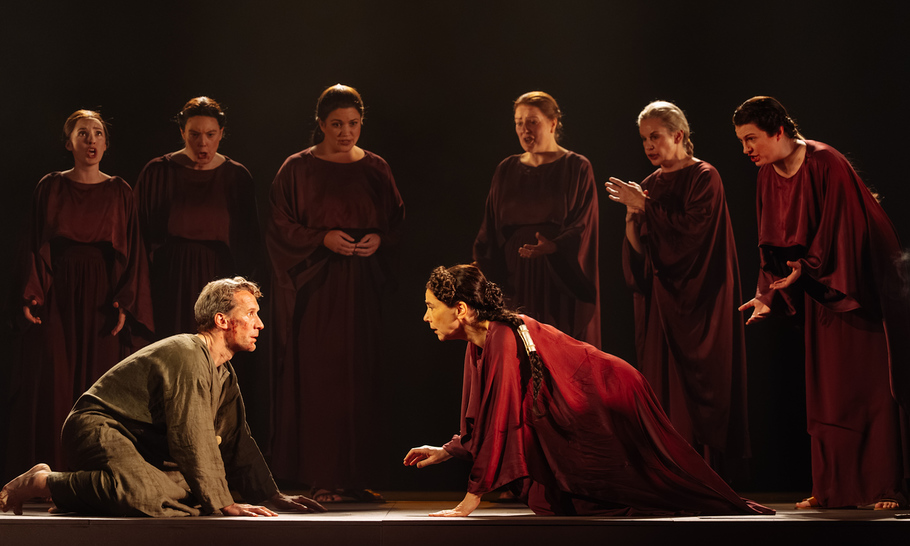
IPHIGENIE EN TAURIDE by Christoph Gluck ;rProduction Photography ;rCast: Christine Rice, Jacques Imbrailo, Nick Pritchard, Morgan Pearse, Olivia Ro...
After a weak opening to the new season, with a gruesome new opera, Angel’s Bone, and an ill-fitting new production of Tosca, it is a relief to report that the English National Opera have a hit with Gluck’s penultimate operatic work, Iphigénia en Tauride. The classical Greek subject matter had already been used for operas by other 18th century composers. By an odd coincidence Goethe’s celebrated German verse drama of the same name had its first performance in Weimar the same year (1779) that Gluck’s opera premiered in Paris, in French of course. The ENO have wisely decided to perform it in the original language, breaking a long tradition of English translations that don’t always work well, and often distort the original meaning of Nicolas-François Guillard’s libretto.
For Christoph Willibald Gluck, this was the crowning achievement of his operatic reforms, which had a great effect on later composers, from Mozart to Wagner. Recitatives were shorter, accompanied by strings and often other instruments rather than just a continuo, and the usual dance movements of French operas are almost entirely absent. The music is wonderful, and conductor David Bates appeared to be enjoying it enormously with the help of the excellent orchestra. The singers were in fine form, with Christine Rice in the title role getting into the intensity of feeling in her role after a somewhat unemotional start. Jacques Imbrailo was full of passion as her unrecognised brother Oreste, and Nick Pritchard was splendid as his devoted friend Pylade, making a fine ENO debut.
The back story is that Orestes killed his mother because she murdered his father: he had sacrificed their daughter Iphigenia for a fair wind to escape port and sail for Troy to join the Trojan war. But unknown to Orestes, his sister Iphigenia had been magically transferred to the land of Tauris — the modern Crimea, then inhabited by Scythians — where she has become the high priestess of Diana. An oracle has prophesied doom for the king if a single stranger escapes with his life rather than being ritually sacrificed. The story really starts when two unlucky Greeks, Orestes and Pylades, have been shipwrecked, and are taken away in chains.
When Iphigenia hears that, like her, the duo come from Argos, she decides to save one of them (both would be asking too much of the gods). Each of the two friends insists that he should be the sacrificial one. Although the chosen victim is to be Orestes, Iphigenia feels an overwhelming reluctance to let him be sacrificed that she only understands when he calls out the name of his sister. At that moment she realises that it’s her own brother. When the Scythians, headed by their king Thoas (Morgan Pearse) arrive to carry out their sacrifice, they are routed by the sudden appearance of the Greeks. No need for the deus ex machina of Diana that Gluck included, suiting this production better to modern sensibilities.
Well done to the English National Opera and the director, Lyndsey Turner, for putting on a terrific show without trying to alter the original text. The surtitles let the audience know what is being sung, so there is no need for English adaptations. Will this production be the start of a new era for the ENO?
A Message from TheArticle
We are the only publication that’s committed to covering every angle. We have an important contribution to make, one that’s needed now more than ever, and we need your help to continue publishing throughout these hard economic times. So please, make a donation.


